Executive Coaching vs. Leadership Consulting: Which Does Your Business Need?

Executive coaching and leadership consulting solve different problems. Learn when to use each, how they differ, and how to get better results from both.
Leadership has never been more demanding. Leaders are expected to set direction through constant change, make faster decisions with less certainty, and build teams that can carry the business toward an ambitious strategy. Many feel unprepared for it. A recent global study of more than 11,000 leaders found that only 17% feel confident anticipating and reacting to change, and 87% worry their skills are being challenged in new ways (DDI, 2026). The stakes are high. Managers account for at least 70% of the variance in employee motivation (Harter & Adkins, 2015), and organizations with effective change leadership are 2.4 times more likely to meet or exceed their financial targets (DDI, 2026). When leaders struggle, their teams and the business feel it.
Large and small organizations are responding with significant investment. In 2025, U.S. companies spent $102.8 billion on training, with management and supervisory training at the top of the list (Training Magazine, 2025), and the global coaching industry now generates an estimated $5.34 billion a year (International Coaching Federation, 2025). Yet closing the leadership gap takes two kinds of help. Some leaders need to build their own confidence, judgment, and adaptability, which is the work of executive coaching. Other challenges sit in the system around them, such as unclear roles, a thin bench, or a team that isn’t aligned, which is the work of leadership consulting. The two are often treated as the same thing. When the wrong tool is chosen, the organization anticipates one kind of help and receives another, and the leadership gap stays open.
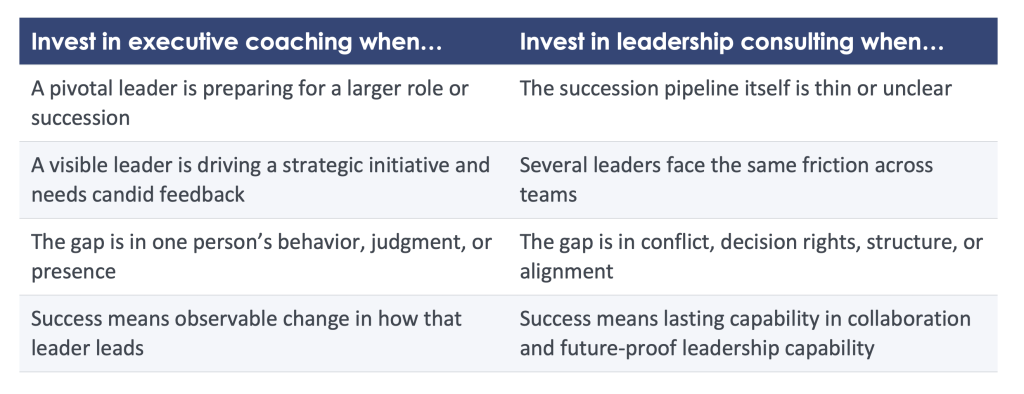
Executive coaching is a confidential, one-on-one partnership that helps an individual leader build self-awareness and change the specific behaviors that matter most in their current or next role. This requires adjustments (i.e., “what got you here won’t get you there”) and accountability to drive the change the leader is striving for.
Leadership consulting is strategic process facilitation delivered to the organization, such as the leadership team or a business function, to strengthen how leaders perform across the company.
Executive Coaching: When One Leader Is the Lever
Coaching delivers its greatest return when individual leader(s) matter disproportionately to the business, such as high-potential leaders, visible leaders driving strategic initiatives, or next-in-line successors. For these leaders, blind spots are costly and honest feedback is scarce. For example, nearly two-thirds of CEOs receive no outside coaching or leadership advice, yet all said they were open to changing based on feedback (Larcker, Miles, Tayan, & Gutman, 2013). Good coaching fills that gap with candid feedback, validation of what is working, and a clear view of the adjustments the role requires.
The returns can be significant. An analysis of 37 controlled studies found that coaching produces meaningful gains in leaders’ effectiveness and consequentially business performance (de Haan & Nilsson, 2023).
Leadership Consulting: When the System Is the Lever
Leadership consulting works on the organization rather than key people. Typical work includes defining leadership expectations, assessing talent for hiring and promotion, and improving team effectiveness. The best consultants create lasting impact without creating dependency by teaching new skills, role modeling or facilitating conflict resolution, or accelerating the change management processes. They clarify decision rights, strengthen communication across teams, and leave behind processes the organization can run on its own. Success is measured by the strength of the bench and how well leadership is prepared to execute the business strategy.
Why the Two Get Confused
Both are often delivered by the same firms and use similar tools, such as interviews and feedback. More importantly, organizational problems usually show up through people. Friction on a leadership team can look like a personality clash, and a struggling leader may actually be sitting in a poorly defined role.
Tips for Using Coaching and Consulting Together
Many organizations need both. When coaching uncovers issues beyond the individual, bring in consultants. When consulting reveals a leader who needs focused support, bring in a coach. If both interventions are needed at once, our experience has revealed the need to contract the services carefully upfront.
- Keep coaches independent. When consulting surfaces leaders who need support, bring in a coach who is not part of the consulting work. This keeps coaching confidential and consulting objective, consistent with professional standards on conflicts of interest.
- Agree on information sharing up front. Decide in writing what will and will not be shared, and with whom. Sponsors need to see themes and progress, and leaders need to trust that their coaching conversations stay private.
- Measure each on its own terms. Track coaching by observable change in the leader, such as feedback from their manager and team. Track consulting by organizational outcomes, such as bench strength, business performance, and team alignment.
The Bottom Line
Before investing, ask what needs to change. If it is how a pivotal leader leads, invest in coaching. If it is the system that leaders work within, invest in consulting. Matching the investment to the problem is what turns leadership spending into real return.
References
DDI. (2026). Global leadership forecast 2027. As reported in Ewen, L. (2026, October 15), Leaders say they are worried about their ability to handle change, HR Dive. https://www.hrdive.com/news/leaders-say-they-are-worried-about-their-ability-to-handle-change/833077/
de Haan, E., & Nilsson, V. O. (2023). What can we know about the effectiveness of coaching? A meta-analysis based only on randomized controlled trials. Academy of Management Learning & Education, 22(4). https://doi.org/10.5465/amle.2022.0107
International Coaching Federation. (2020). ICF code of ethics. https://coachingfederation.org/ethics/code-of-ethics
International Coaching Federation. (2025). 2025 ICF global coaching study: Executive summary.
Larcker, D. F., Miles, S., Tayan, B., & Gutman, M. E. (2013). 2013 executive coaching survey. Stanford Graduate School of Business and The Miles Group.
Martin, A., Carter, A., Blackman, A., & Sinclair, A. (2020). Exploring coachability. Institute for Employment Studies.
Training Magazine. (2025). 2025 training industry report.

View Profile