
Entrepreneurship Teaching Tools for High School Educators
Research-based, interactive modules designed for flexible classroom use
EIX provides free, research-based teaching modules that educators can use to enhance instruction in entrepreneurship, business, marketing, economics, and STEM classes. These lessons were originally developed for college-level coursework and adapted for secondary classrooms, with an emphasis on entrepreneurial mindset and design thinking.
Most modules can be used in a single class period, a 2–3 day mini-unit, or an extended project, allowing educators to integrate them easily into existing courses and units.
How to Use This Resource Hub
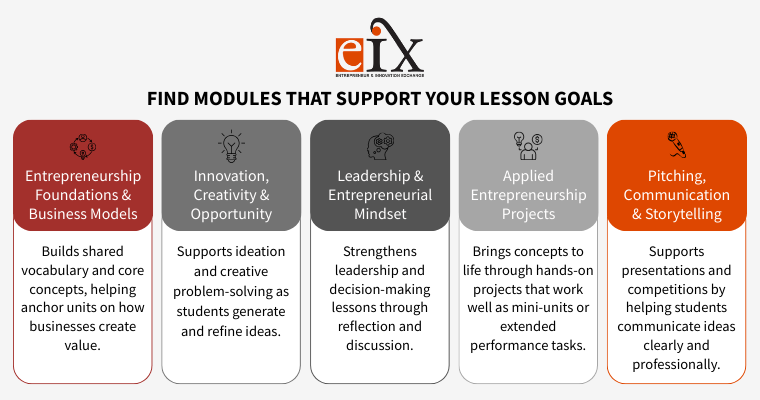
To reflect how educators plan and teach, modules are organized by instructional purpose. This structure makes it easier to identify lessons that align with unit goals, pacing needs, and classroom activities.
Educators might, for example:
- Start with Entrepreneurship Foundations when launching a unit or introducing core concepts
- Select Innovation or Leadership lessons to build engagement, mindset, or creative thinking
- Choose Applied Projects when students are ready to create, test ideas, or work through hands-on mini-units
- Use Pitching and Communication modules to support presentations, showcases, or culminating assessments
Each module appears once in the category that best reflects its primary instructional focus, though many lessons can be adapted for multiple uses. Brief descriptions highlight common secondary uses to support flexible integration into different courses or pacing guides.
A time-based planning guide is included further down the page to support lesson and unit scheduling.
Find Modules That Support Lesson Goals
What’s Included in Each Module
Modules include three core components. Specific materials may vary slightly by lesson.
-
Educator Resource Guide
Pacing options, facilitation steps, discussion prompts, teaching tips, and common challenges and solutions.
-
Student Packet
Clear learning objectives, project flow, reflection questions, and simple assessment guidance.
-
Printable and Shareable Handouts
Student-facing pages designed for quick printing or digital sharing.
Entrepreneurship Foundations and Business Models
Core concepts and frameworks that fit naturally into introductory units.
These modules support instruction on how businesses create value, test ideas, and operate under real constraints such as uncertainty, resources, and market conditions.
Introduction to Business Models

A foundational lesson that complements introductory coursework on how businesses create, deliver, and capture value.
Common secondary use: extends into multi-day business analysis activities.
Introduction to the Business Model Canvas
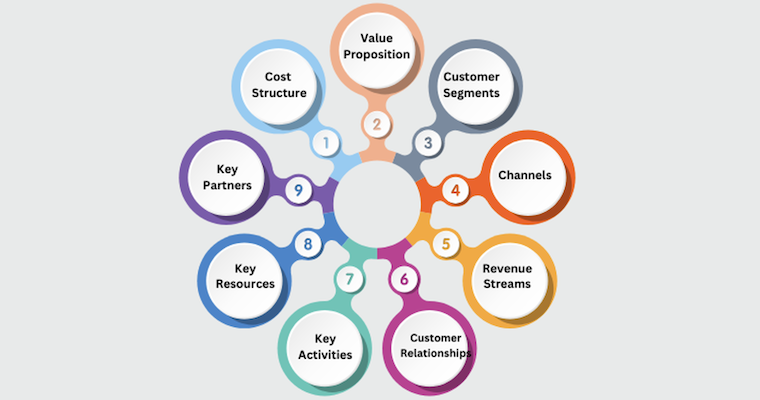
A structured tool-based lesson that reinforces strategy, value creation, and basic venture planning.
Common secondary use: works well as a multi-class sequence or recurring framework across a unit.
Invention vs. Innovation in Business

A concept lesson that supports units on innovation, product development, and competitive advantage.
Common secondary use: effective as a one-class discussion and analysis lesson.
Coin Toss Game: Luck, Skill, and Structural Constraints

A high-engagement activity that supports discussion of uncertainty, opportunity, and the role of structure in outcomes.
Common secondary use: a strong opener for mindset, ethics, or decision-making lessons.
Innovation, Creativity, and Opportunity Recognition
Lesson options that strengthen ideation, creative thinking, and opportunity recognition.
These modules support students in generating ideas, connecting concepts, and exploring innovative approaches to problem solving. They work well as stand-alone creativity lessons or as enhancements to broader innovation units.
Customer Discovery for High School Entrepreneurs

A practical introduction to identifying customers, understanding needs, and testing assumptions.
Common secondary use: expands into a short applied project within marketing or entrepreneurship units.
Bisociation (Mixing Ideas)

A creativity lesson that complements ideation and innovation instruction through structured idea-combination.
Common secondary use: quick warm-up before product, marketing, or venture projects.
LEGO® Serious Play for Ideation

A hands-on method that strengthens collaboration, communication, and creative problem solving through building and storytelling.
Common secondary use: works well as a 2–3 day mini-unit or as a project kickoff.
SNL Viable Business Models

A memorable and rigorous activity in which students redesign an improbable idea into a viable business model.
Common secondary use: adaptable as a short lesson, mini-unit, or project launch activity.
Leadership, Mindset, and Entrepreneurial Thinking
Resources that support leadership development, reflection, and entrepreneurial habits of mind.
These lessons complement instruction focused on leadership, resilience, creativity, and decision-making, and can be integrated into advisory, career readiness, or entrepreneurship units.
Taylor Swift: Fearless Leadership and Creative Expression

A culturally relevant lesson that supports leadership, creativity, and reflective thinking.
Common secondary use: engagement hook, advisory lesson, or unit opener.
Applied Entrepreneurship Projects
Project-based modules that support performance tasks and applied learning.
These modules are designed for extended student work and can serve as central projects or as enhancements within existing project-based courses and CTE pathways.
$5 Seed Money Challenge

A structured mini-venture project that supports ideation, planning, execution, and reflection with minimal resources.
Common secondary use: works well for entrepreneurship clubs, intensives, or capstone experiences.
Introduction to Social Entrepreneurship

A module that supports units on mission-driven ventures, impact models, and ethical decision-making.
Common secondary use: cross-curricular connections to civics, environmental topics, and community-based learning.
Pitching, Communication, and Storytelling
Resources that support presentations, showcases, and student communication skills.
These modules complement project work by providing structure for student pitches, presentations, and public communication.
Pitching Your Business Idea

A practical lesson that supports clear communication, audience awareness, and presentation structure.
Common secondary use: final presentation support for multiple project types.
How to Host an Innovation Challenge

Planning guidance and facilitation tools for pitch events, showcases, and judging.
Common secondary use: capstone event support across entrepreneurship and CTE programs.
Planning by Time Commitment
Each module includes pacing guidance. The examples below provide a general planning reference when selecting lessons to match scheduling needs.
One Class Period
- Coin Toss Game
- Invention vs. Innovation
- Pitching Your Business Idea
- Bisociation
- SNL Viable Business Models
2–3 Day Mini-Unit
- Introduction to Business Models
- Business Model Canvas
- LEGO® Serious Play
- Customer Discovery
- Social Entrepreneurship
Extended Project
Articles and Insights for Educators
EIX also publishes research-based articles and case studies that can support course planning, professional learning, and instructional enrichment.
Empowering Students for Tomorrow: Expanding Entrepreneurship in High School Education
Today’s fast-changing job market brings new challenges—and high school is the perfect time to help students build skills for navigating it. This article explores how entrepreneurship education can empower students with critical thinking, adaptability, and an entrepreneurial mindset to thrive in a world where career paths are shifting.
Should Cell Phones Be Banned in Classrooms?
Join UNC-Chapel Hill’s Professor Howard Aldrich as he shares with Kimberly Eddleston what happened when he decided to ban phones in class—and why he believes more schools should consider it.
Could IMSA’s TALENT Program Be the Model for High School Entrepreneurship Education?
Discover how IMSA’s TALENT program equips high school students with real-world skills in entrepreneurship, problem-solving, and innovation. This hands-on program serves as a blueprint for how entrepreneurship education can transform students’ futures—before college.
Scaling Success: How a Class Project Became a Franchise Triumph
Learn how Joe Keeley turned a class project into College Nannies and Tutors, a thriving franchise. This case study offers students a hands-on look at essential business concepts like market strategy, franchise growth, and entrepreneurial problem-solving, showcasing real-world skills in action.
About These Resources
These modules are adapted from research and instructional materials originally developed for university-level entrepreneurship courses and published on EIX. They are offered through the collaboration of EIX and the Richard M. Schulze Family Foundation.
Educators are encouraged to use, adapt, share, and revisit this hub as new modules and to receive updates when new modules are released, subscribe to the EIX newsletter.