
Three More Strategy Tools Every Small Business Owner Should Know

The Value Chain, PESTEL, and Competitive Analysis can help entrepreneurs understand where they create value, anticipate market shifts, and compete more effectively.
In a previous EIX article I examined four foundational strategy tools that can help entrepreneurs and small business owners think more systematically about competition, positioning, and financial viability: Porter’s Five Forces, SWOT analysis, customer value propositions, and unit economics. These tools provide a practical starting point for moving from reactive decision-making to deliberate strategy.
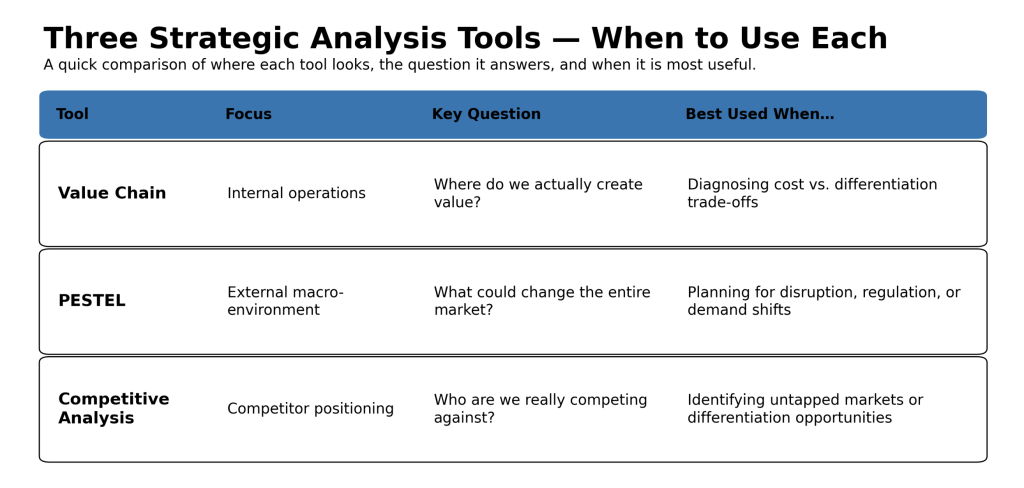
But strategy does not have to stop there. Three additional tools—the Value Chain, the PESTEL model, (Political, Economic, Social, Technological, Environmental, and Legal), and Competitive Analysis—help business owners think more deeply about how value is created inside the firm, how external forces reshape industries, and how competitors influence customer expectations. Like the other frameworks discussed in my earlier article, these tools are not reserved for large corporations or MBA classrooms. Applied thoughtfully, they become highly practical decision-making tools for entrepreneurs and small businesses.
Where Do You Actually Create Value? The Value Chain
Introduced by Michael Porter in his 1985 book “Competitive Advantage: Creating and Sustaining Superior Performance,” the Value Chain breaks a business into the activities that create value for customers and incur costs for the firm. The framework helps managers understand where the business is genuinely differentiated, where costs accumulate, and where improvements can create competitive advantage.
For a small business owner, this framework forces a simple but powerful question: Which activities actually encourage customers to choose us—and which activities simply consume resources?
Consider a local bakery. At first glance, the owner may think the business is simply about baking products. But a Value Chain perspective reveals something broader: Ingredient sourcing affects quality; production affects freshness and waste; social media affects visibility; delivery capability affects convenience; and employee interaction affects loyalty and referrals.
Viewed this way, competitive advantage rarely comes from one isolated activity. It often comes from how several activities reinforce one another.
For example, if the bakery discovers that customers consistently praise personalized service and custom cake consultations, that insight may suggest reallocating resources away from low-margin commodity products and toward premium specialty orders where the business can differentiate itself.
A Value Chain analysis also helps separate “busy” from “valuable.” Many small firms unknowingly devote significant time and expense to activities customers barely notice while underinvesting in activities that directly influence customer satisfaction and retention.
What Could Change the Entire Market? The PESTEL Model
Many businesses fail not because management misunderstands competitors, but because management ignores broader environmental shifts occurring outside the industry itself.
That is where the PESTEL model becomes useful.
PESTEL examines six categories of external forces: Political, Economic, Social, Technological, Environmental, and Legal.
The framework encourages owners to step back from daily operational pressures and consider larger trends that could reshape customer demand, operating costs, regulation, labor markets, or competitive dynamics.
Consider a neighborhood fitness studio. A PESTEL analysis quickly surfaces several external trends:
- Technological: The growth of digital fitness platforms is reshaping how customers access and evaluate workouts.
- Economic: Inflation pressures are affecting discretionary spending and membership renewal rates.
- Legal: Evolving labor classifications for independent trainers create compliance risk.
- Social: Increased customer focus on wellness and mental health is expanding the definition of what a fitness studio should offer.
- Environmental: Rising energy costs and customer expectations around sustainability are influencing facility operations and brand perception.
Importantly, PESTEL is not simply an academic exercise in “trend spotting.” It should influence concrete decisions. For many businesses today, artificial intelligence represents one of the most consequential technological forces to analyze through PESTEL. A local accounting firm, for instance, might discover that AI-powered tax software is rapidly lowering the barrier for customers to handle routine filings themselves—compressing demand for entry-level services and pushing the firm toward higher-value advisory work it may not yet be staffed or priced to deliver. Mapping that shift explicitly, rather than dismissing it as distant, is precisely what PESTEL is designed to prompt.
PESTEL does not eliminate uncertainty. But it improves preparedness.
Who Are You Really Competing Against? Competitive Analysis
Small business owners often define competitors too narrowly.
While Porter’s Five Forces examines the overall structure and attractiveness of an industry, Competitive Analysis focuses on the specific firms competing for customers today—their strengths, weaknesses, positioning, and likely actions.
A coffee shop thinks it competes with the coffee shop across the street. A local gym thinks it competes only with another local gym. In reality, customers compare alternatives far more broadly.
The local coffee shop may also compete against convenience stores, home brewing systems, energy drinks, remote work habits, and food delivery apps.
Competitive analysis helps business owners understand not just who competitors are, but how competitors position themselves, what capabilities they possess, and where vulnerabilities may exist.
A useful starting point is to examine four basic questions:
- Who are the major competitors—including indirect ones?
- What are they doing well?
- Where are they vulnerable?
- How are customer expectations changing because of them?
Answering these questions does not require a research team. Customer reviews on Google, Yelp, and social media reveal what people value—and what frustrates them—about competing options. Visiting or interacting with competitors directly, observing their pricing, and monitoring their promotional activity provides additional detail. Brief conversations with customers about alternatives they considered before choosing you can be among the most revealing data points of all.
Suppose a local independent bookstore notices that a national chain is aggressively discounting bestsellers online. Competing directly on price may be impossible. But competitive analysis may reveal something equally important: The chain cannot easily replicate local author events, curated recommendations, children’s reading groups, or strong community relationships.
That insight shifts the strategic conversation from “How do we match their price?” to “How do we compete differently?”
The Three Tools at Work
Consider a local fitness studio facing slowing membership growth. A Value Chain analysis might reveal that its greatest source of customer value is not the equipment itself but the quality of its trainers, personalized coaching, and sense of community. A PESTEL analysis could identify broader forces affecting the business, including the growth of AI-enabled fitness applications, inflationary pressures on discretionary spending, changing consumer wellness preferences, and evolving labor regulations affecting independent trainers.
Competitive Analysis would then examine how rival gyms, digital fitness platforms, and boutique studios are responding to these same trends. Viewed together, the three tools provide a more complete strategic picture. The Value Chain identifies where the firm creates value internally, PESTEL highlights external forces that may reshape the market, and Competitive Analysis reveals how competitors are positioning themselves in response. Rather than reacting to events as they occur, the owner can make more informed decisions about investments, service offerings, pricing, and differentiation.
The Complete Toolbox
The earlier EIX.org article on Four Strategy Tools Every Small Business Owner Should Know focused on understanding competition, defining value, and ensuring financial viability. The fitness studio example above illustrates how this article’s three tools extend that foundation—diagnosing internal operations, anticipating external shifts, and mapping the competitive landscape simultaneously.
Together, these frameworks encourage entrepreneurs to keep internal operations, external environmental shifts, customer expectations, competitor positioning, and long-term sustainability in mind at all times.
Most small business owners already possess deep operational knowledge. What these tools provide is structure—a disciplined way to organize observations, identify patterns, and make more informed decisions.
None of these frameworks is exhaustive, and no single tool fits every situation. Their value lies in the questions they force owners to ask—before circumstances force difficult answers.
The Bottom Line
Strategy is not about producing complicated reports. It is about identifying challenges early enough to shape outcomes rather than merely react to them.
The Value Chain, PESTEL, and Competitive Analysis—like the frameworks discussed in the companion article—help entrepreneurs move beyond intuition alone and think more systematically about where value comes from, what threats are emerging, and how the business should respond.
No framework guarantees success. But in an environment where competitive pressure, technological change, and customer expectations evolve rapidly, businesses that think strategically can adapt faster than businesses that simply react.
That adaptability may ultimately prove the most important competitive advantage a small business can build.
Learn More

View Profile
