
'Turning Around the Titanic:' An Entrepreneur’s Fight to Keep Going
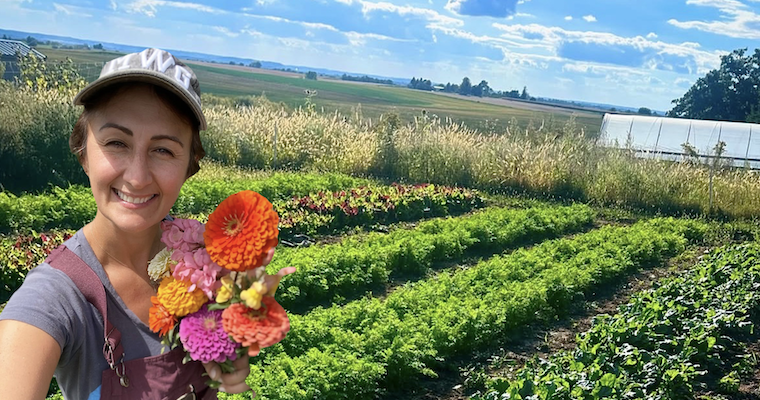
In a candid interview from Mayo Clinic’s Hope Lodge, City Girl Farming founder Justyna Miranda explains how she’s navigating a rare cancer diagnosis—and why resilience is a business strategy, not a slogan.
I met Justyna Miranda late last year at one of the most vulnerable times in my life: as I undergoing treatment for cancer at the Mayo Clinic in Rochester, Minnesota. Justyna was fighting her own battle with adrenocortical carcinoma, a rare cancer that affects one in 1 million people. We were both staying at Hope Lodge, a free residence for Mayo Clinic patients and their families. Retired Best Buy Founder and CEO Richard Schulze, who also funds EIX and FamilyBusiness.org, has funded 12 Hope Lodges in Rochester and around the country.
Justyna’s health crisis has disrupted her ability to run the business she founded in Iowa: City Girl Farming, which aims to bring fresh, delicious, real food to local residents and give them a greater connection with the farmers who provide it. But it hasn’t disrupted her spirit, and she is determined to continue growing her business and giving more people access to fresh, local food.
In this interview, we talked about Justyna’s entrepreneurial journey, which dates back to her childhood in Communist-era Poland. She also shares how she came to America, found her passion after years of studying and working for others, and how she is dealing with her current health challenge, which she compares to “turning around the Titanic.” Her story holds remarkable lessons about resilience, an essential quality for anyone who runs a business.
Below are the highlights of our interview and an audio file of our full discussion.
Interview Highlights
Jim Wetherbe: I’m Jim Wetherbe, founding editor of EIX, and I’m sitting down today with a special guest: Justyna Miranda, a fascinating entrepreneur. We’re recording from an extraordinary place: the Hope Lodge in Rochester, Minnesota, right next to the world-famous Mayo Clinic. Hope Lodge has an interesting background tied to EIX’s founder (and the founder of Best Buy), who created it as a cost-free place for cancer patients to stay while getting treatment—treatment that can last weeks or months and be financially impossible for many families. He didn’t just help create this one; he helped create 12 Hope Lodges around the country.
Today’s conversation is especially personal: Justyna is here battling cancer, and I happen to be battling cancer here too. We met at Hope Lodge, and her story is the kind that can offer real insights to aspiring entrepreneurs, which is what EIX exists to do.
Growing up in Poland: scarcity, curiosity, and a grandmother who “made it work”
Jim: I usually ask entrepreneurs whether there was something in childhood that sparked entrepreneurship. But your childhood was different. You were born in Poland before the Berlin Wall came down, in a very isolated, economically deprived environment.
Justyna Miranda: I don’t think I thought about “entrepreneurship” as a kid. But I’ve always been curious about the world, with this internal feeling that what my small town offered wasn’t enough—that there was more out there. I was young, so I didn’t fully understand the isolation. But I remember waking up with my grandmother and going into the gardens she kept—pulling radishes, collecting eggs, picking tomatoes. Almost every inch of the property was used because of scarcity.
My grandmother was really my role model. She took matters into her own hands and made the best life she could out of what we had. In that sense, she was an entrepreneur.
I also remember walking and seeing this huge line outside the main store in town. I asked my mom what it was, and she said my grandmother was standing in that line because they were delivering food—meat—and she was trying to make sure there would still be enough by the time she got to the front to buy some for the month. That’s how rare it was.
When the Berlin Wall came down, it was formative. Suddenly we were flooded with Western culture—jeans, bubble gum, Coca-Cola, movies. It opened my eyes to the world outside and what a person might be able to achieve.
‘This is where I’m supposed to be:’ getting to America
Jim: At some point you wanted to come to America—and you found a practical way to do it: becoming an au pair.
Justyna: I was a strong English student, and my parents had high expectations for my education. I chose English as one path, hospitality as another, and I pitched The Au Pair in America Program as a “sabbatical”—a chance to improve my language skills and come back with a better shot at the schools they had in mind. It wasn’t cheap; my parents invested in it. But it worked out. I came to Chicago—Oak Park/River Forest area—in January 2000, I was 19 years old.
I landed in New York first, and I felt—immediately—like this was where I was supposed to be. My spirit felt it. Thinking back, subconsciously, right then, I almost knew I wasn’t going back. I can’t fully explain it, but I felt completely hooked—as if I’d landed where I belonged.
Restaurants, discipline, and a mentor who helped shape her trajectory
Jim: You were an au pair, but your career path didn’t move in a straight line.
Justyna: Not at first. I didn’t know the ropes. I had bartending experience, so I started working the club scene—and I made so much money I thought, “Why would I go to college?” I had abundance for myself and could still send money to my family. I stalled school for a long time. The club scene got old real fast , and I started working at a French restaurant right when it opened. I got to experience the business being developed from the beginning—and that’s where my entrepreneurship journey began, because I could watch ownership decisions being made in real time.
My mentor was Chef Chris Ala, the chef-owner of Hemmingway’s Bistro and his wife and business partner Lucia Ala. They saw that I connected easily with people, that I worked hard, and that I showed up. And I had to—because I didn’t have family here or anyone to fall back on. Discipline wasn’t optional.
Education later in life—and a shift from ‘making money’ to ‘meaning’
Jim: You didn’t just stay in restaurants; you built credentials, too.
Justyna: I became a Level Two sommelier, and later I went back for a four-year degree in my 30s. I started at Triton College in Elmhurst and eventually transferred to Kendal College in the City of Chicago. I even had to do math prerequisites, but I pushed through. I was working towards Hospitality Management degree but during the culinary portion of the curriculum I considered switching majors, because cooking - learning all the proper skills and techniques, all of it felt so natural to me. Ultimately and largely due to bureaucracy involved, I decided to remain in the Hospitality Management program, with solid culinary training included as part of ithe degree.
Food had always been central in my life. My grandmother cooked every day, a labor of passion, and we looked forward to sitting at the table together. I took that culture for granted until I came to the U.S. and saw how many people didn’t have access to nutritious, real food.
Jim: After graduation, were you still working in the restaurant?
Justyna: I was. Then Triton College offered me a position as an adjunct—teaching management and dining room management—so I slowly weaned off the restaurant, working there maybe three days a week and teaching the rest. It was a great opportunity, but I started to feel like something was missing: values, purpose.
Around that time my father died from the disease of alcoholism. Following that, my mom and I took trips to bond and give ourselves the space to grieve —Italy one year, then and Spain the following one —and I could provide that because of my income. But when I came back, I realized I didn’t want to report to a boss anymore. I wanted the freedom to do things my way. I didn’t know exactly what the “thing” was yet. I just knew it had to do with food—and it wasn’t opening a restaurant.
At some point the idea clarified: I wanted to make a difference. I wanted to use my skills to address what felt not right. And entrepreneurship became, surprisingly, less about some grand external achievement and more like a discovery of self.
City Girl Farming: reconnecting to food and people and removing friction
Jim: You didn’t open a restaurant, but you did create something innovative in food. Tell us about what you built in Iowa.
Justyna: After almost two decades in Chicago, I moved to Iowa through a relationship. The relationship didn’t survive, but my stay in Iowa did. I was drawn to the Dubuque area—the tri-state region—in the Driftless region on the Mississippi River. It’s beautiful. And I wanted out of restaurant interiors. I wanted to be outside, in a garden, reconnecting to what I grew up seeing with my grandmother.
I started working at a collaborative farm run by the Dominican Sisters, supporting farmers who didn’t have access to land. I learned proper farming techniques and equipment. I did eventually start working at a restaurant again, but at back of the house: cooking, a very different experience, intentional and needed towards my new trajectory. I’d bring in crops I grew and prepare them for guests.
That experience clicked: seeing something I worked hard to grow become a simple, beautiful dish— carrots, for example—enjoyed by someone. It also made me confront a problem: produce is time- sensitive. People intend to eat healthy and buy from small farmers, but the friction is real: access, time, cooking skill. Too often the food ends up in the garbage or, hopefully compost. So I decided: I’m not only going to grow this food. I’m going to cook it and turn it into convenient meals that community members can heat up and eat—so they can feel good about supporting small farmers and eating well.
Jim: And that became City Girl Farming and Prepared Meals.
Justyna: The name came from the reality—and the irony—of it: a “city girl” farming. It sounded authentic, so I ran with it. I didn’t know it would grow into what it became.
Jim: You also shared something unusual: You never hired anyone.
Justyna: I did start as a minority partner with another business. I had 30%—not real decision-making power. I worked hard and felt like I was onto something, but when I had ideas for changes, I was shut down. Still, through that period I built relationships with people who showed up later when I was running my own show.
When cancer hits: 'I can’t even get a normal cancer'
Jim: Along this journey, cancer struck—which meant two challenges at once: entrepreneurship and cancer. What happened?
Justyna: Cancer gave me an opportunity to drop everything and look at my life. It felt like a strange divine energy—like things came to me as I intended. I’d developed a sustainable business that supported me. I had a great team and momentum.
Then a series of hits came fast: We received a $50,000 USDA grant, and it was immediately frozen due to an administration change. My kitchen rental situation changed with an unexpected rent increase. And then I found out I had a one-in-a-million cancer. I even joked: “There’s nothing normal about my life—I can’t even get a normal cancer.”
The diagnosis was traumatic. I was sent to the ER after my PCP received lab results that I had insisted on having done, which ultimately confirmed my concerns. For some time I had felt that something wasn’t right. I had also noticed swelling in my legs - signs that raised concerns about clotting, and a possible pulmonary embolism. When they scanned my legs and didn’t see clots, it seemed like I might be fine. Then the doctor and nurse came in and said not only did I have bilateral embolisms in my lungs, but there was a large mass below my lungs.
They needed another CT scan; they thought it was cancer. I was alone in the ER room. At first I was convinced it wasn’t real, like I was dreaming. Then I became hysterical, I called my partner David Hartig and my dear friend Debi Butler, a major supporter of my business, for whom I was scheduled to cook later that day. They came as I tried to process and take the next steps.
Jim: And you had a one-pound tumor removed.
Justyna: Yes. A one-pound tumor was removed. Everything stopped. But because of my friends Debi and Andy Butler, who were influential due to their extensive philanthropic contributions, I was able to get admitted to Mayo Clinic. That’s where treatment began, and where I began what I call my relationship with cancer.
Which is harder: entrepreneurship or cancer?
Jim: So what’s been more challenging—to be an entrepreneur, or to battle cancer?
Justyna: I decided this could not be the end of my story, because I had finally found my purpose. I’d created something and worked so hard. I’d had moments where I thought, “This is insane—what are you doing?” But to reach a point where you can prove to yourself it’s possible—and to have a team that shares your values—there’s no way cancer gets to be the final chapter.
I’ve even described my goal as “turning around the Titanic.” That’s my archetype. If I’m going to choose a goal, it’s going to be something hard—worthy of my will because I have a strong one. And if you want to turn around a Titanic, you’re going to be transformed. Part of it is letting go. So I convinced myself: this cancer is a chapter I need to go through to continue the bigger mission.
Even though I’ve made peace with the reality that life might end—for any of us, at any time—I also believe life is an experience: fast, challenging, a contrast of pain and joy. And there’s joy to be found in everything.
If one is “harder,” I’m not sure. Entrepreneurship is hard because there’s no immediate reward. Even when you get the reward, you can feel like you missed the journey. And many entrepreneurs never stop working because it becomes part of who they are.
'Work smart, not just hard,' and build around your weaknesses
Jim: Purpose clearly gave you motivation to fight, and you’ve had support from your team. That matters.
Justyna: One of the biggest lessons for me now is: it’s about working smart, not just hard. For a long time, working hard was the only thing I knew. But you have to recognize your strengths—and especially your weaknesses—and fill those gaps so you can thrive in your strengths. That was huge for me.
A closing note on generosity—and being 'seen'
Jim: One of the things Dick Schulze often says is, “To whom much is given, much is expected.” I admire him enormously. I watched him build Best Buy, and I’ve watched him be smart and generous as a philanthropist—creating Hope Lodges like this. This place accommodates about 120 people, and many couldn’t get treatment here without that philanthropy. So I want to give you a chance to say anything you’d like to Dick.
Justyna: Oh my gosh, yes. This journey still hasn’t fully descended on me. I was on a wait list for Hope Lodge, and then I got in. And the first people I met were your wife, and you—and then I learned about Mr. Schulze and what he has given. It feels like another lifeline, something that keeps my story going.
I still don’t fully understand why me, or how I deserve it, but I’m deeply grateful. And I hope I can keep passing on that generosity of heart to others—because people believed in me and saw me for who I am. I think one of the greatest gifts you can give someone is to see them and accept them for who they are, so they can thrive authentically. It took me time to arrive at my authentic self—to accept that I am enough and what I have to offer is good enough—and then to grow from that place, supported by the people I met along the way.
Listen to the Full Interview
View Profile