
The Right and Wrong Way to Find a Franchise

This structured framework helps you narrow thousands of options to a short list—by balancing personal fit, economics, industry trajectory, and franchisor quality.
If you want to become a franchisee, your first step is to choose a franchise brand and then buy a unit—a daunting task given the thousands of franchise opportunities to choose from.[1]
But, where do you start? What’s important to look at, and what is just noise? To help you with that, we have a framework that narrows down your choices from thousands of opportunities to a half-dozen or so that make sense for you. But first, let’s review a few common alternative ways of finding a franchise – including some that you shouldn’t pursue.
Approaching Franchisors and Brokers
It is common for people to search for a franchise by contacting franchisors directly, or by working with intermediaries called brokers. Brokers are often called “consultants” in franchising; we like to call them “matchmakers” because that’s what they do.
The good news is that if you reach out to franchisors or franchise brokers you will receive a ton of interest. Why? Because franchisees bring their capital and labor with them and are the prime drivers of franchise system growth. Every franchisor wants qualified franchisees, and many people will happily help you find a franchise. That can be a smart choice for a lot of people. Brokers and sales reps will work with you, understand your goals, and line up some options—like a real estate agent showing you properties.
However, if you use a broker be careful that they do not push you into a decision you’re not comfortable making. Buying a franchise can be a life-changing experience and you need to make a well-informed decision to buy or not buy. That’s your decision to make, not the decision of a broker or sales rep.
The other way to get into franchising is to do what we advocate: research your own opportunities. By doing your own research you will have a better idea of what you truly want; you’ll understand your personal costs better; and you’ll be able to get into franchising on your timeline. You will also drive the process which provides you with greater control and power.
The Wrong Way to Get Into Franchising
Finding the right franchise involves both intellectual and emotional components. Unfortunately, most people focus too much on one or the other, but not both. For example, people will devote their entire attention to the economics: How much does it cost? What’s the ROI? How much money will I make? Others focus 100 percent of their attention on the emotional aspects: I really like this business. The people and culture are a perfect fit for me. I can see myself really enjoying this.
Focusing on either extreme can quickly lead you astray, and what looked like a dream opportunity can turn into a nightmare reality.
A Framework For Evaluating Franchises
Our framework provides a comprehensive, well-rounded, and balanced view of franchises that serves as an objective reference guide. If you want finer-grained results you could create your own weighted system—but don’t give a weight of “zero” to any item, as tempting as that may be.
Consider your own passion and talents
It seems obvious, but ask yourself honestly: what do you like to do? What are you good at? What is pure drudgery for you? If you don’t like kids, do not buy an education franchise; if you don’t like pets, don’t buy a dog or cat service franchise. Even if the numbers work for you and you can afford a franchise, if you don’t personally like the business category or environment, you will likely struggle.
Look for franchises where you have a natural tendency to excel, or a natural affinity to enjoy. If you are a detailed introvert, it’s best to avoid a B2B franchise that requires you to go out and network, meet new people, and then sell them your products.
If you don't have genuine enthusiasm for the business itself, don't buy it, because as you get more involved, the brand becomes your identity. Being honest with yourself at this stage will pay dividends later because you will be able to rule out a lot of great opportunities that aren’t “great” for you.
Consider the economics of the business
A first step is answering the questions: What kind of capital do you have? What kind of borrowing power do you have? What kind of credit score do you have? In short, what's your economic or financial capacity?
With $1 million you could you buy a franchise that costs $1.2 million -- Is that doable? Sure, you could get a loan from the SBA for the $200,000 shortfall, but is that smart? Probably not, because you will definitely need reserves or contingency capital.
But, if you keep most of your cash you will take on too much debt. Then you’re just working for the bank and you’ve never going to really benefit—you’re going to pay off your debtors first and you may never capture owner benefits.
We’d suggest investing half of that $1 million in a new deal and keeping the other half for backup if things go wrong. Or, if things go right, you can use your capital ideally for a second or third unit, because that follow-on capital is important to create scale and even better returns.
Most people underestimate the total investment for a franchise business, and they take whatever the franchisor provides them as a true estimate of costs. To really understand the economics you have to build your own model, ask lots of questions, and see what those numbers mean for you.
For example, in selling PostNet franchises, potential franchisees would say that they needed to replace their salary of $100,000 in household income in year one. Getting into a PostNet franchise costs $200,000, and after a year or two you could get to breakeven. If you became an excellent operator, that store might make $400,000 and you might net 15%, which is $60,000—still short of your $100,000 goal. If you need to make $100,000 next year and you only have $200,000 to invest, you need a 50% return on investment in the first year.
If you find a franchise where you can predictably earn a 50% return on investment in the first year, call us back because we’ll buy 10 of those. It just doesn't exist, so if you’re going down this path, you need to go back and revise your economic model and get more realistic.
If you really need to make $100,000 then you should invest $1 million and expect to make a 10% return. It’s almost impossible to buy a franchise for $200,000 and expect a 50% return, especially in the first few years.
Consider the trajectory of the underlying industry
When a new category emerges in an industry it seems like a winner, but no industry is immune to market shifts, changing consumer preferences, and new and better competitors. We’ve seen franchise concepts come and go, especially retail locations with products and services that can be purchased cheaper online and delivered for free to the consumer.
What’s the long-term innovation curve for the industry? Is it going to be obsolete anytime soon? Is it a fad or a trend? A “movie” we’ve seen several times is where a new franchise emerges, gets hot and grows quickly, and then copycat franchise systems enter. Five years later, the whole category is saturated. Be wary of hot concepts that are trending without a historical track record.
Consider the skills to be successful
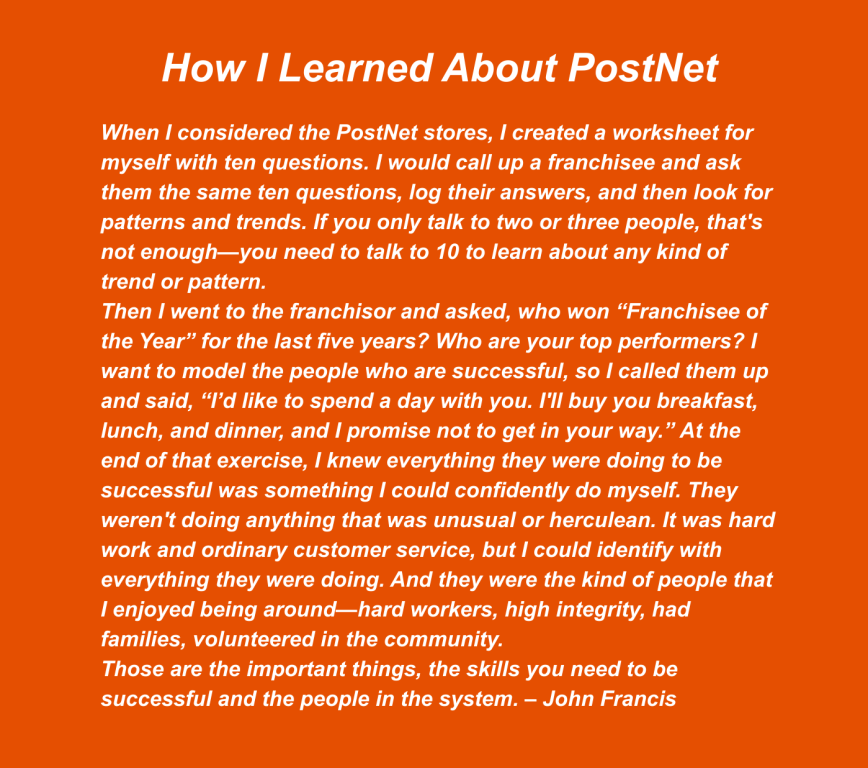
What does it take to be successful in a franchise? Don’t just accept what you hear from the franchisor or a franchise broker but verify what it takes to be successful. We recommend you talk to at least 10 franchisees in an existing brand and, if you can, go visit them at their store. This is called “validation,” and it’s a critical step that deserves time and attention. An in-person visit is critical because what those franchisees are doing is what you're about to do. Figuring out who they are and what makes them successful or not successful, and understanding how closely your skills and experience correlate to theirs, is important to know before you buy a franchise.
Consider the people and culture of the brand
When you buy a franchise you are joining a brand that has a culture. Every franchisor will tell you what their culture is, but you have to validate and understand that for yourself. You can do that by visiting multiple individual franchisees, visiting the headquarters office, getting to know the leadership and staff, or if possible, attending their annual brand conference.
Some franchise systems will allow candidates to attend their brand conference and they'll say, “You know, you didn't buy the franchise, but we want to show you who we are. So come spend a day at our conference.” And it can be really powerful for most people because they get to experience the training; they get to meet the vendors; they get to see the people and the awards. They get a vivid sense of what it would be like to be a franchisee in that system.
A lot of franchisees are looking for that sense of belonging that you get by being part of a larger organization. As a franchisee you are now part of this brand “family” that you don’t control, and you will want to get a sense of what that family feels like before you commit to it.
For understanding the firm’s people and culture, you need to do your due diligence by talking to the owners, visiting the stores, and talking to the people at headquarters. Ask yourself: Are they happy? Successful? Are they angry and hostile? If you buy a franchise, you’re joining that culture—You’re not going to be able to change the culture. So, take the time to understand who is involved in the franchise, what their values are, and what it takes to be successful. Decide if that culture aligns with you, because that’s a critical aspect of choosing a franchise to join. It’s easy to get into a franchise, and not as easy to get out, like a lot of things in life.
Consider the leadership and ownership of the franchisor
One factor that is often overlooked when evaluating franchises is the leadership of the franchisor and the ownership structure. Most early-stage franchisors are private small startups and it’s worth asking them about their goals and ambitions. Do they have a long-term view of growing the franchise? Are they committed to franchisee success, or looking out only for themselves? Are they founders or hired talent? Are they planning a private equity transaction? Are they going to roll up other systems and be a category consolidator?
It's sometimes difficult to evaluate, but it's always worth asking these questions. If they're not willing to tell you, or they don’t know, that’s a red flag. If they do know and do tell you, then you get to decide if this is something you want to be part of.
Brand ownership and leadership can and will likely change over time, and that impacts franchisees. Over the past 15 years we have seen a lot of private equity transactions, and while some of them work out, others are not good for the franchisee. The costs change, the culture changes, and every day is a battle. And because you’ve signed a contract, you have to stick with whatever the PE firm owner wants—Franchisees do not have an opt-out clause in their contract.
Think through your exit
If you don’t like the franchise system; if you bought it with one culture and it morphs into something very different; or if your franchise is acquired by a Private Equity firm and things go wrong, or you get new leadership not aligned with franchisees—if any of those things happen, you can always sell your business. But it’s tough to sell a franchise, especially if people aren't happy or the brand and unit-level performance has weakened
Are you going to make anything when you sell it? Are you just going to give it away? The leadership component is also an important factor to think about in connection with exit – not only in how the franchise system operates but also in how systemwide changes impact you as a would-be seller.
Conclusion
All the components of the framework we recommend are helpful in sifting through the variety of franchise concepts to find the half-dozen or so that meet your criteria. And it is also important to keep in mind that most franchisees, at some point, will want to sell their unit. That is when people and culture, underlying industry dynamics, and brand leadership come into play. You may be super-excited to buy a franchise, but going into it with some thinking on your exit can possibly be a deciding factor. Rather than just hope for the best, it’s better to have a full understanding of all of the franchise dynamics before you invest your hard-earned money. Take your time, do your homework, get good advice, and make a careful, well-informed decision. If you are prepared to work hard and follow the franchise model, you too can be a successful franchise business owner.
[1] In an earlier article we shared how franchising has evolved from single-unit operators to franchisees creating multi-unit, multi-brand empires.

View Profile

View Profile