
Why Better Innovations Fail: What Netflix Got Right About Adoption
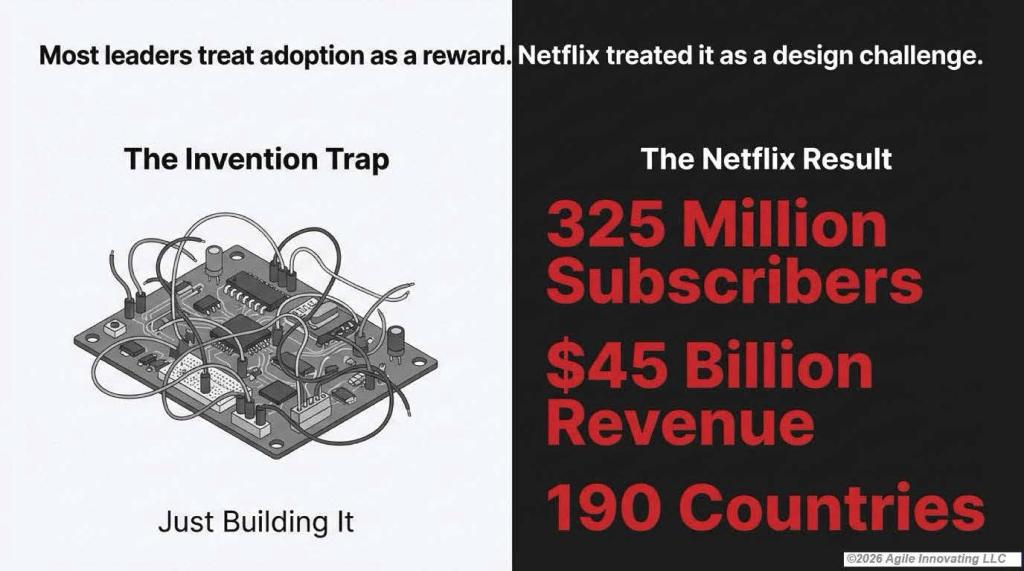
Many companies build better products and still lose. Netflix shows that innovation is not just invention or launch: It is getting people to switch, stay, and make your solution the new default.
Over a 40-year career in R&D, new product development, and product management in six industries, I’ve seen many innovations fail. Nearly all of them follow the same pattern: A company builds a genuinely better solution. The technology works; early customer reviews are promising; but then adoption stalls.
This happens not because the solution is wrong, but because the organization never understood something critical:
Building a great new solution and getting it adopted are two entirely different problems.
I found that most leaders treat adoption as the reward that follows a successful launch of their innovation. They are getting it backwards. Innovation happens only when people adopt your solution and substitute it for their existing one. A new solution sitting unused is not an innovation. It's just a novel invention.
True innovation requires two non-negotiable elements: a genuinely better net user experience, and less net user trouble because the total cost and effort of switching is lower than sustaining the status quo. No other company understood this better than Netflix.
How did Netflix, a startup that nearly closed its doors in 2000, become a company with 325 million subscribers and $45 billion revenue in 2025, become the embodiment of this difference in perspective? Netflix's journey maps almost perfectly onto a framework I developed called the Innovation Adoption Ladder — seven sequential challenges every new solution must overcome to become an innovation. Miss any single step, and your innovation joins the long list of cautionary tales. Here is how Netflix pulled followed this framework step by step.
Step 1: Developing Attractiveness
Most innovators mistake novelty for attractiveness. Netflix didn't. When Netflix launched in 1997, the novelty was real: movies arriving in your mailbox ordered from a website. But Reed Hastings understood that novelty has a short half-life. The question Netflix asked wasn't "How do we get attention?” It was "What makes us durably better than the alternative?”
Their answer was specific. Blockbuster had limited shelf space; Netflix had access to thousands of titles. Blockbuster charged late fees; Netflix eliminated them entirely. Blockbuster required a trip to the store; Netflix came to you. When Netflix introduced the subscription model in 1999 -- with a flat monthly fee, unlimited rentals, no due dates, and no late fees -- they created attractiveness built on structural superiority, not novelty.
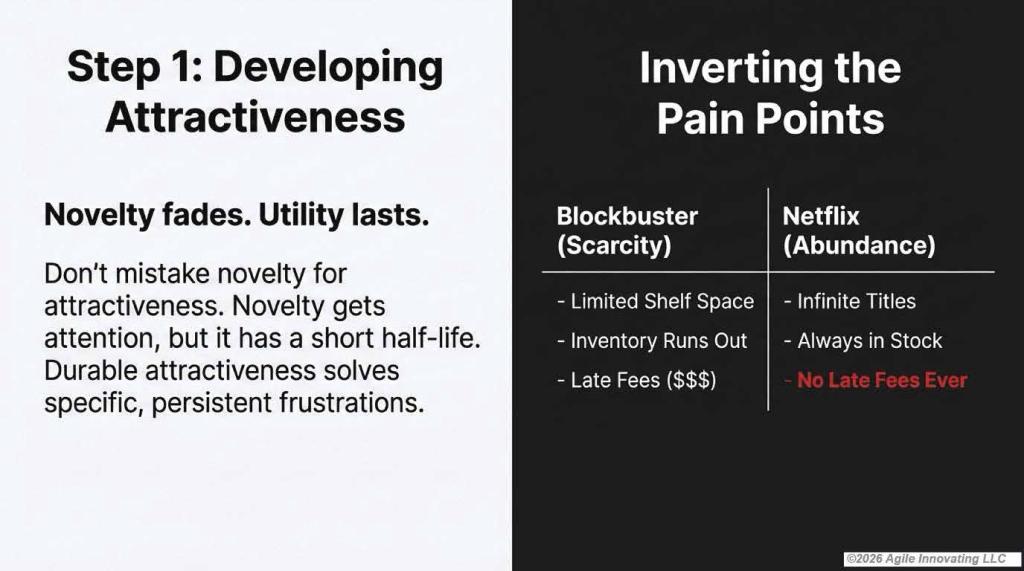
The lesson: Novelty opens the door. Durable attractiveness requires designing against the specific, persistent frustrations with existing solutions.
Step 2: Creating Awareness
Most innovators approach awareness backwards. They invest heavily in announcing their solution before they've made people aware of the problem they’re solving. Netflix ran the sequence correctly. Their early marketing didn't lead with "DVD by mail.” It led with Blockbuster's most hated policy, the late fee.
The late fee was Blockbuster's biggest revenue line and its most hated customer experience. It was effectively a tax on customers for behavior the business required to survive. Netflix made that fee the centerpiece of their awareness strategy. They also used catalog breadth as a second awareness tool. By showcasing titles unavailable at local stores, Netflix made customers aware of movies they'd wanted but never found. This surfaced a Blockbuster limitation that customers had been tolerating without fully recognizing it. Before Netflix customers clicked subscribe, they already understood what they'd been missing.
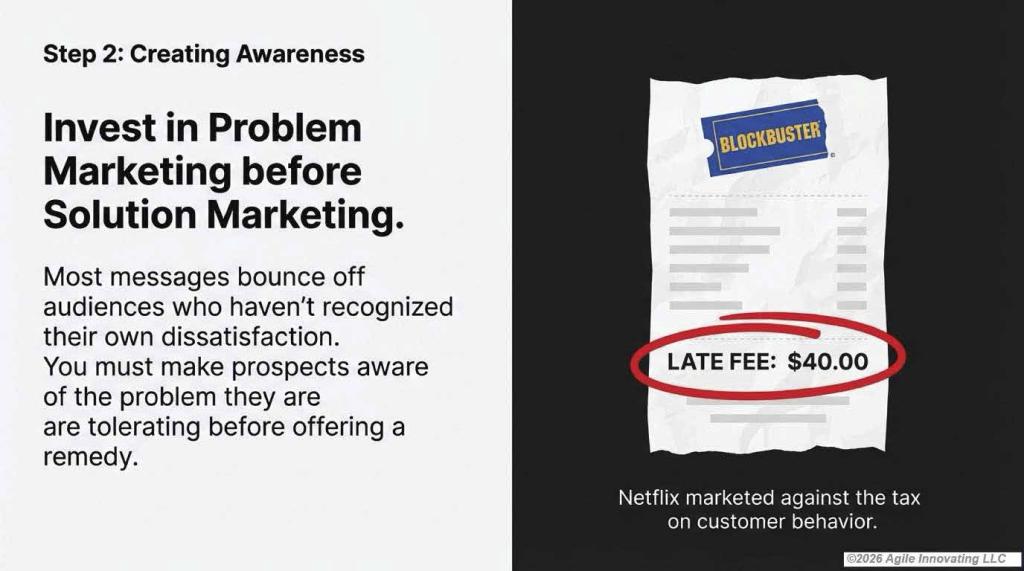
The lesson: Before investing in solution marketing, invest in problem marketing. Make your audience aware that what they're currently doing isn't necessary or worth tolerating.
Step 3: Providing Accessibility
Accessibility can fail in two directions. Most innovators focus on one and ignore the other. The supply side asks, “Can we reliably provide the solution at scale?” The demand side asks, “Can customers easily obtain it when, where, and how they need it?” Netflix worked to solve both challenges simultaneously.
Their supply-side challenge was significant. At first Netflix operated from a single distribution center, and slow delivery times created customer dissatisfaction. Netflix's response was to build regional warehouses for overnight delivery nationwide. By 2005, they were shipping one million DVDs per day.
Their demand-side solution was the “Subscription Queue,” which they introduced in 1999. Members built a ranked list of titles in advance. When a disc was returned, the next one shipped automatically — no login required, no new order, no recurring friction. Netflix's research showed the average customer rented five to seven movies per month. The queue eliminated most of the effort of staying subscribed and getting movies.
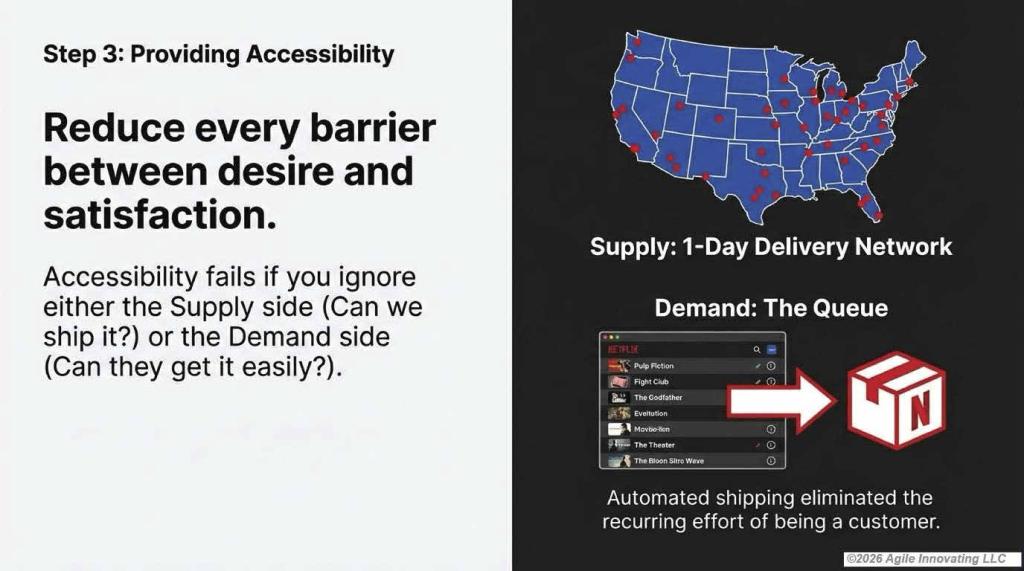
The lesson: You can't solve just the supply side or just the demand side challenges. Both must work in the same direction, reducing every barrier between the customer's desire and your ability to satisfy it.
Step 4: Assisting Acquisition
Broad adoption is a social process. It doesn't begin everywhere at once. It begins with specific, influential early users whose validation enables the next wave.
Netflix's early acquisition strategy shows exactly how this works. Netflix launched in 1997 with no formal marketing announcement, yet 500 orders arrived on day one, almost exclusively from early DVD enthusiasts on Usenet groups. These weren't ordinary consumers. They were the people already obsessed with the DVD format who found the Netflix site and told their personal networks immediately. Within 30 days orders reached 1,000 per day. Within 90 days, they exceeded 2,000 per day.
The second acquisition move was more deliberate. Netflix negotiated a "ten free rental" coupon that was included inside the packaging of every DVD player sold by Panasonic, Sony, and Toshiba, the three manufacturers holding 85% market share. The coupon was added last on the packaging line, making it one of the first things customers saw when opening their new player. Netflix paid nothing for the placement. The manufacturers had a strong incentive, giving their new hardware an obvious use case. The acquisition channel was self-funding and reached exactly the right early adopters.
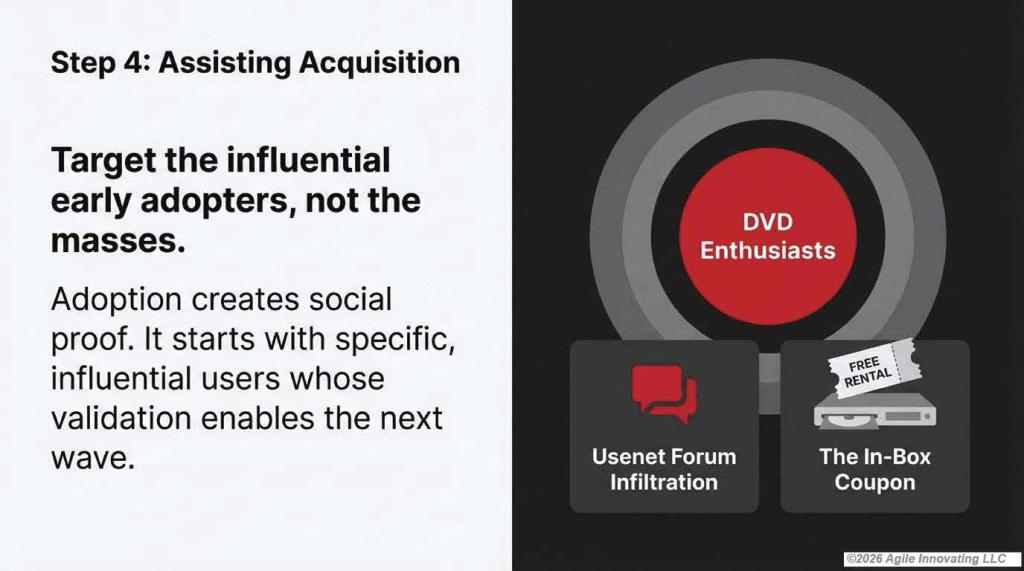
The lesson: Don't make your product generically available and hope the right people find it. Identify who your most influential early users are. Then reach out to them through channels they already use.
Step 5: Encouraging Acknowledgement
Getting early users to adopt is necessary but insufficient. You need two more things: verification that they're genuinely experiencing the value you promised, and amplifying that validation to a broader audience. Netflix built both mechanisms directly into their product offering with Cinematch.
Launched in 2000, the Cinematch recommendation algorithm analyzed rental history and user ratings to surface films customers might never have found on their own. The algorithm got smarter with every rental and every rating, creating visible, personalized evidence of value with each interaction. The effect on customer retention was measurable. Active recommendation users churned at significantly lower rates. By 2009, Netflix achieved a 90% subscriber renewal rate. Today, approximately 80% of subscribers use Netflix's recommendations. When users told others, "Netflix recommended this and it was great!” they were doing acknowledgement work at no cost to the company.
In 2006, Netflix launched the Netflix Prize, a $1 million award to any developer who could improve the algorithm's accuracy by more than 10%. The contest attracted global attention from data scientists, generated significant press coverage, and sent a clear signal that Netflix's competitive advantage was knowing what customers wanted and that they were investing to deepen that knowledge.
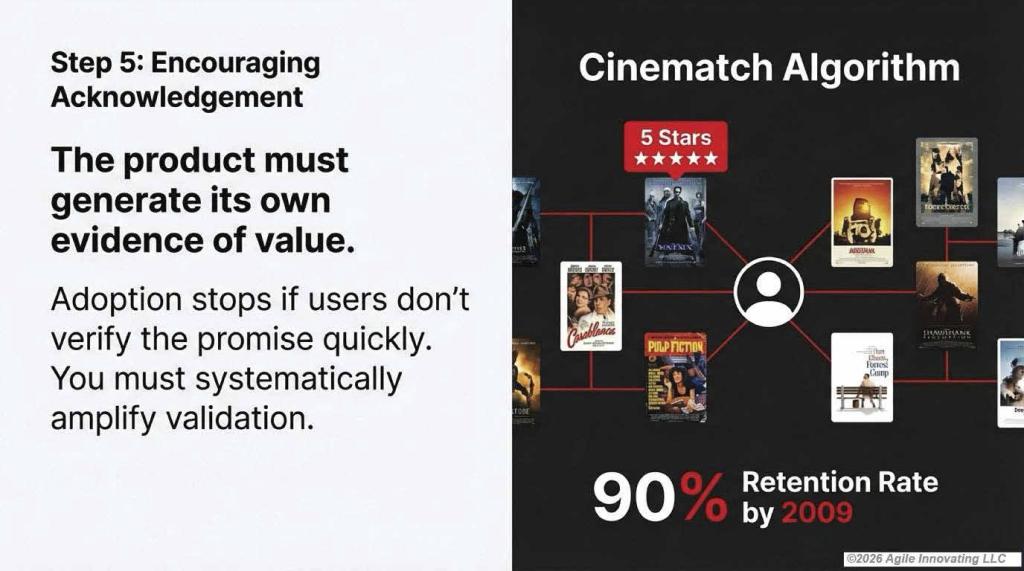
The lesson: Design for acknowledgement. Build mechanisms that make the value visible, measurable, and shareable. Then amplify what users naturally experience.
Step 6: Confirming Approval
This is where many innovations die -- not because they don't work, but because the total trouble of switching remains too high, even when users acknowledge the experience is better.
Approval requires two things working together simultaneously: a verified better experience, and an acceptable total switching cost. Netflix addressed every dimension of the user experience and of switching trouble. On the financial side, a free trial meant customers could experience Netflix without canceling Blockbuster. A no-hassle cancellation policy meant they could leave easily with no traps. Netflix's confidence in the user experience made the offer viable. On the behavioral side, eliminating late fees removed all anxiety around holding a disc longer than planned. There were no return deadlines to manage, and no guilt about an unwatched movie sitting on the coffee table. The new behavior required dramatically less consumer effort.
Netflix also built trust through transparency. When their 2011 plan to split streaming and DVD into separate services triggered backlash, costing them 800,000 subscribers in the short term, Netflix reversed the decision. Consumers recognized Netflix as a company that prioritizes what customers actually want. Customers who trust a company have a lower psychological switching cost.
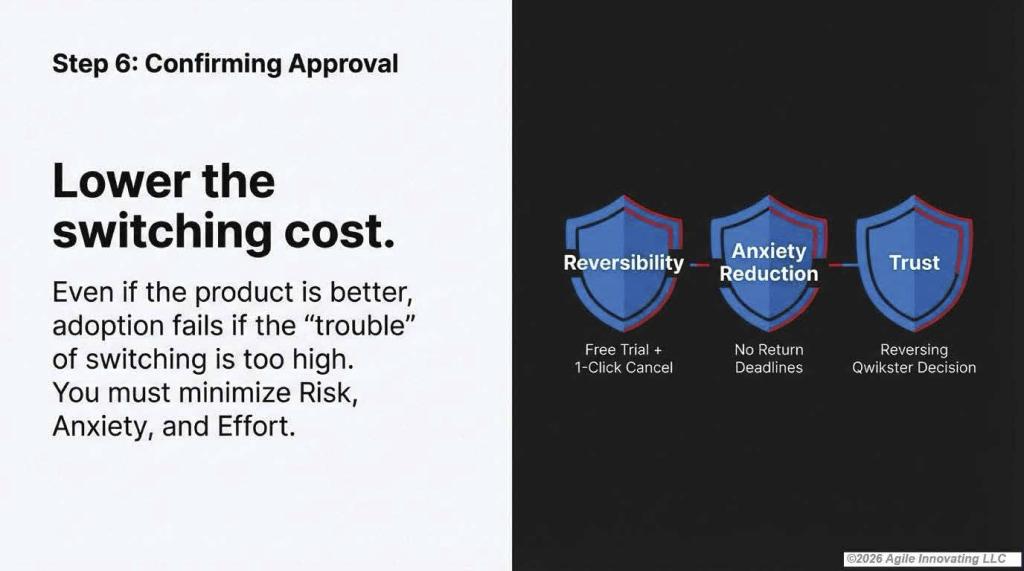
The lesson: Don't just build something that is “better.” Actively identify and minimize every element of switching trouble. The total friction must be acceptable or approval won't happen regardless of solution quality.
Step 7: Propelling Adoption
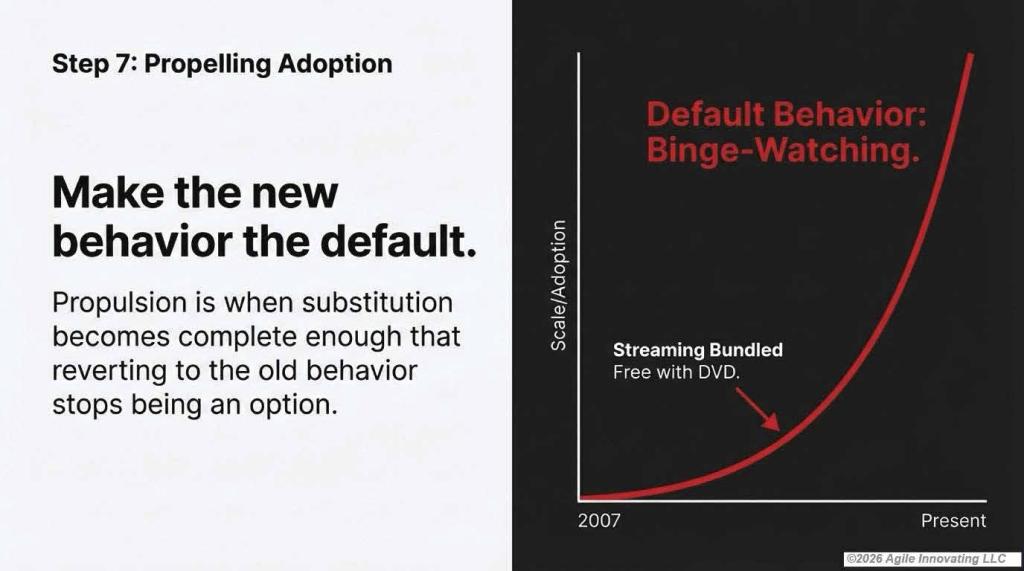
The summit of the ladder is where adoption achieves scale. It's where your solution becomes the new default. It's where substitution happens at the market level. Netflix has climbed to this summit twice: once with DVD-by-mail, and again, at far greater scale, with streaming.
The streaming launch in January 2007 started modestly: 1,000 titles, broadband required, a browser plugin needed. But Netflix had been building toward streaming since the company's founding. The DVD business was always the vehicle for reaching the customer base that would eventually stream. When the infrastructure supported it, Netflix moved.
Their propulsion strategy was methodical. Streaming was bundled with existing subscriptions at no additional cost, inviting -- not demanding -- behavior change. The result was 21.5 million subscribers by 2011, a 283% increase from 2007, with streaming becoming the majority of viewing hours. The behavior change that followed was irreversible. "Netflix" became a verb. Binge-watching became a standard consumer behavior. Full season releases, beginning with “House of Cards” in 2013, replaced weekly broadcast scheduling. An entire generation stopped thinking about “movie night" and started thinking about "What am I watching next?” When substitution is complete enough that reverting to the previous behavior stops being a live option, that's propelled adoption.
The Final Scoreboard
In 2000, Netflix offered to sell to Blockbuster for $50 million. Blockbuster declined. In 2010, Blockbuster filed for bankruptcy. In 2025, Netflix exceeded 325 million subscribers, generated $45.2 billion in revenue, and announced a deal to acquire Warner Bros.
What are the lessons of the Netflix Journey for Innovation Leaders and Entrepreneurs?
An innovation doesn’t happen by accident. The consistent thread across all seven steps isn't genius, luck, or an innovation hero. It's the refusal of leadership to treat adoption as an afterthought.
Netflix engineered every step deliberately. Attractiveness was designed against specific competitor failures, not built solely around novelty. Awareness led with the problem before the solution. Accessibility solved supply and demand challenges simultaneously. Acquisition targeted the most influential early users through channels they already used. Acknowledgement built the validation mechanism into the core product. Approval systematically identified and lowered every switching barrier. Propelling Adoption included preparing for streaming years before the technology was ready.
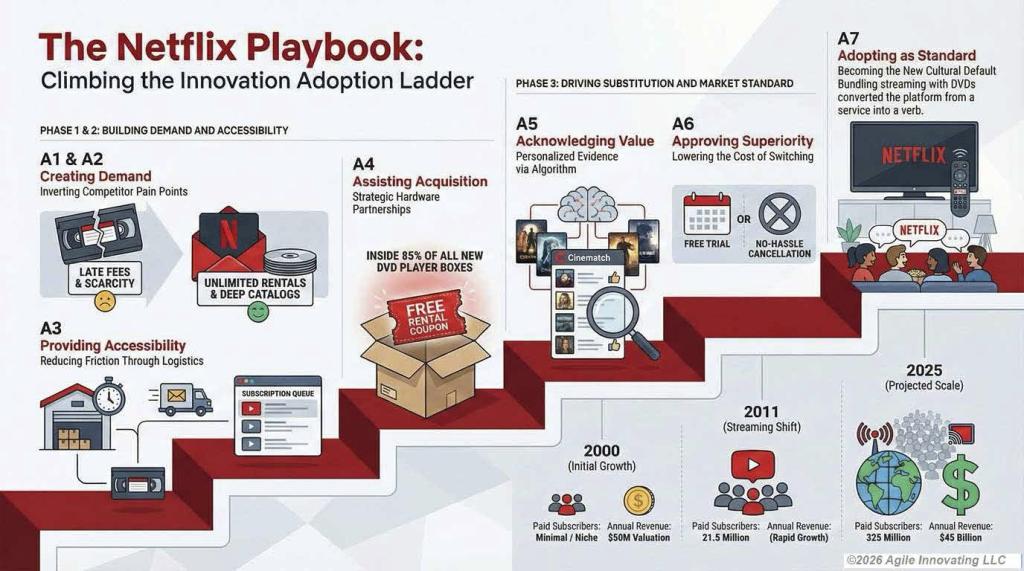
Utilizing this framework, you can now diagnose where your innovation initiative is stuck if your new solution isn't becoming an innovation. No initial interest points to an Attractiveness problem and the need to create and highlight clear superiority over the existing approach. Awareness without trial signals an Accessibility barrier -- on the supply side, the demand side, or both. Trial without retention means switching trouble exceeds perceived value. Modest Adoption that won't scale means propulsion hasn't been fully addressed.
Find the bottleneck, and engage the entire organization in performing the right work for that specific step. I learned that innovation is an organizational outcome, not a functional one, requiring significant organizational alignment. Don't move forward until your organization has aligned and cleared the current challenge. Adoption shouldn’t be the outcome you hope for after building something great. It's the organizational outcome of the adoption process you design before the first prototype is built. The Adoption Ladder is the same for every business. Your results depend entirely on how deliberately you climb it.

View Profile

